As a Christian, lawyer, and former state Senator, I’ve watched the Christian community being roiled by legislation proposed in multiple states to “abolish abortion”. The rhetoric between those on different sides of the legislation distresses me for reasons I’ve not seen previously considered: Are those on the two sides doing a righteous work or a good, but dead one?
As a strict matter of mere conscience only, many people are excited or moved to do many “good works.” But, shockingly, Scripture often characterizes them as “dead works.” The distinction between spiritually good works and dead works or what Isaiah calls “righteous deeds” that are but “filthy rags” before God keeps coming to mind as I observe the ungenerous rhetoric that often accompanies supporters and opponents of this legislation.
The reason for this recurring thought is a present recognition that, Scripturally-speaking, I would characterize the twelve years I spent serving in the Tennessee Senate as a “dead work,” even though I led the first-ever successful ballot measure to remove abortion as a state Supreme Court-declared “right” under a state Constitution.
It was a good work for sure. And, it was done out of a conscience that believed abortion was murder. God, strictly by His good providence, has used that work to protect Tennessee from the many efforts now being made to make abortion a state constitutional right. Nevertheless, I would now characterize my work as spiritually dead for reasons that I will come to. But first to the legislation at hand.

God alone can rightly judge the hearts and intentions of those who advocate and oppose changes in state law that would treat the killing of an unborn person by abortion the same as the killing of a born person. He alone, by the Holy Spirit, can inform a person’s heart and mind as to whether his or her work on this legislation (or any other legal or policy matter) is a righteous or a dead work.
Note: I use the word homicide rather than murder because state laws distinguish between types of killing such as premeditated, knowing, etc.. And, it is usually up to a local District Attorney to decide whether to indict a person and determine what kind of homicide to indict for.
The legislation in Tennessee gives the district attorney a choice between indicting the abortive woman for first degree murder, which carries the death penalty or life in prison; or second degree, which carries a minimum sentence of 15 years up to 60.
Personally, I have argued in briefs filed with Supreme Courts of Iowa and of the United States that the common law informs the meaning of the word “person” in the Fifth and Fourteenth Amendments. And, there is no doubt that common law understood the word “person” in law to include the “child in the mother’s womb.”
I doubt any truly pro-life person would say this common law principle is wrong, even though many legal advocates have not previously made that argument.

It seems to me the point of division is the penalty for homicide by abortion.
Some want to treat the matter of the law’s sanction and the judicial processes associated with enforcement of the sanction as distinct from whether unborn persons should be treated as equal in the eyes of the law. For them, the statement of principle in the law defining homicides is the fundamental point.
However, this separation between the nature of the crime and its punishment is impossible. Even God’s law cannot be fully appreciated apart from its curse and sanction, death. (See Galatians 3:13; 1 Corinthians 15:56)
Regarding punishment, some abortion abolitionists insist that the death penalty should apply to the abortive mother -- the same as with any other pre-mediated homicide. Those on the other side have their reasons for continuing to place no punishment on the mother or impose one less than death or multiple years in prison.
However, my concern today is not punishment, but how Christians go about their “work” on abortion in the eyes of God and what we are communicating to a predominately unregenerate population that knows nothing of the good news that Jesus Christ is.
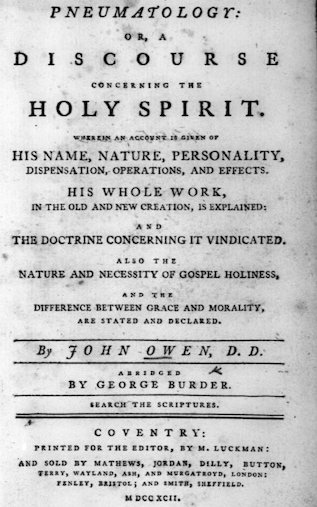
To address this most fundamental of issues -- the spiritual nature of our work -- I turn to John Owen. Owen was a 17th century Puritan who advised Oliver Cromwell and preached to Parliament. His thoughts, along with those in his Meditations and Discourses on the Glory of Christ, led me to conclude that my past “good works” were dead ones.
The following is a slight modernization of passages from his extensive work, Pneumatology, principally from Chapter 4 of Book 3.
The whole course of our obedience to God in Christ is the “life of God,” Ephesians 4:18, — that life which is from him in a peculiar manner, whereof he is the especial author, and whereby we live unto him. Living unto Him is our end. And the gospel, which is the rule of our obedience, is called “The words of this life,” Acts v. 20, — that which guides and directs us how to live to God.
Hence all the duties of this life [of God] are vital acts, spiritually vital acts, acts of that life whereby we live to God. Where this regenerated principle of life does not exist, all the works of men are dead works. Where persons are dead in sin, their works are “dead works.” (emphasis supplied)
They are so -- all of them -- either in their own nature, or with respect unto those performing them. Hebrews 9:14. They are dead works because they proceed not from a principle of life, are unprofitable as dead things (Ephesians 5:11), and end in death eternal (James 1:15). (emphasis supplied)
The principle of [Adam’s] life was wholly and entirely in man himself. It was the effect of another cause which was outside of himself, namely, the good-will and power of God; but it was left to grow on no other root but what was in man himself. It was wholly implanted in his nature, and therein did its springs lie. That original life in Adam received it influence from the power from God, for no principle of operation can exist independent of God, nor apply itself unto operation without his concurrence. (emphasis supplied)
But in the life whereunto we are renewed by Jesus Christ, the fountain and principle of it is not in ourselves. It is but in him, as one common head unto all that are made partakers of him. He is “our life;” and our life, as to the spring and fountain of it, is hid with him in God, Colossians 3: 3, 4; for he quickeneth us by his Spirit, Romans 8:11. And our spiritual life, as in us, consists in the vital actings of this Spirit of His in us; for “without him we can do nothing,” John 15:5. By virtue hereof we “walk in newness of life,” Romans 6: 4. We live, therefore; yet not so much we, as “Christ liveth in us,” Gal. ii. 20. (emphasis supplied)
There is a difference between these two animating sources of spiritual life with respect unto the object of their vital acts. That’s because the life which we now lead by the faith of the Son of God has various objects of its actings which the other had not. For though all the actings of our faith and love (Galatians 5:6), which is to characterize all our obedience, now respects the revelation that God makes of himself and his will unto us. (emphasis supplied)
Whatever duties towards God men may perform, if they are not enlivened by a supernatural faith and love, they do not belong to that spiritual life whereby we live to God. They are dead works.
On this question, I depart from quoting Owen to offer my take on 1 Timothy 1:5-7 for consideration:
Now the end (telos) of the commandment is charity out of a pure heart, and of a good conscience, and of faith unfeigned: From which some having swerved have turned aside unto vain jangling; Desiring to be teachers of the law; understanding neither what they say, nor whereof they affirm.
At one time, this rather “ambiguous” end or telos of the charge or command that we have from Christ in the gospel would have seemed to me antinomian to the core.
However, the regenerate know themselves to be objectively and metaphysically new creatures because in them the image of God in the person of Christ has been restored as the animating principle by which they partake of a spiritual “life of God.” That life was once unknown to me, but my present knowledge and experience of it explains why Paul’s view of law makes perfect sense to me now.
To walk by the Spirit is not the same thing as doing good works out of a post-Fall, Adamic conscience pressed to duties as works of the law. By such works, no person is justified in God’s sight nor will his or her works be deemed righteous by God.
Those who are strictly “teachers of the law” may not (yet) have this understanding. Their works may be good in the eyes of many, but they may also be dead. I was one of those persons during my Senate tenure, but my works were spiritually dead, because I was.
Only the Holy Spirit can give a person an answer to whether their works, and the tenor of them, are dead ones. But, in time, “[e]very man's work shall be made manifest: for the day shall declare it, because it shall be revealed by fire; and the fire shall try every man's work of what sort it is” (1 Corinthians 3:13, KJV).